

Cricket bats in four willow grades as 3D solids in AutoCAD
One bat per English willow grade built as lofted 3D solids in AutoCAD, with mass from 1.111 to 1.210 kg and A3 drawings checked on 13 dimensions.

The video plays from YouTube’s privacy-enhanced player only after you click it.
SphereHarness designed cricket bats in Autodesk AutoCAD as 3D solids, one per English willow grade, from the dimensions of an earlier analysis study. The Grade 1 bat measured 1.111 kg in AutoCAD, 8 % under the analysis bat, and the four grades range from 1.111 to 1.210 kg.
What was asked
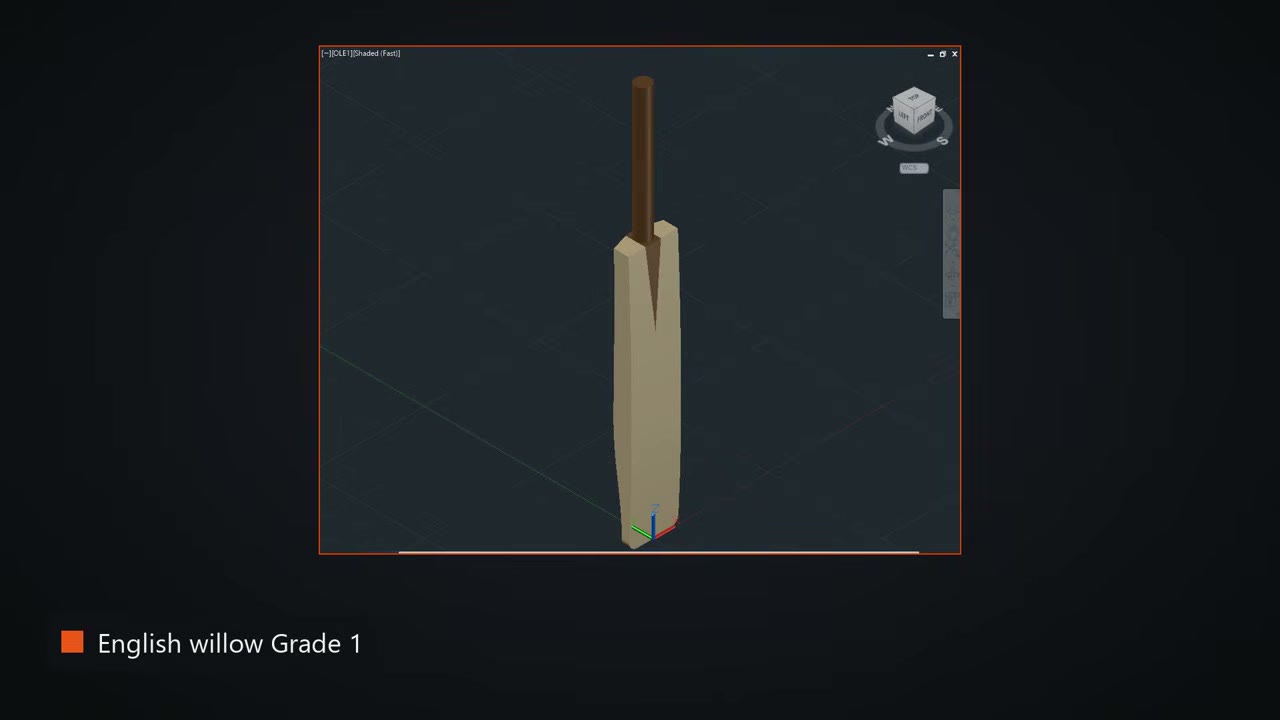
The agent was given the dimensions and the willow values in plain words: the sizes, the shape and the material values for English willow Grade 1 (density 380 kg/m³, Young's modulus 6.0 GPa, Poisson's ratio 0.37, bending strength 48 MPa, compression strength 25 MPa). The request also asked for the willow blade and the cane handle to stay two separate solids, a light willow colour on the blade and a darker one on the handle, and the file saved as CricketBat_EW_Grade1.dwg.
What the agent did
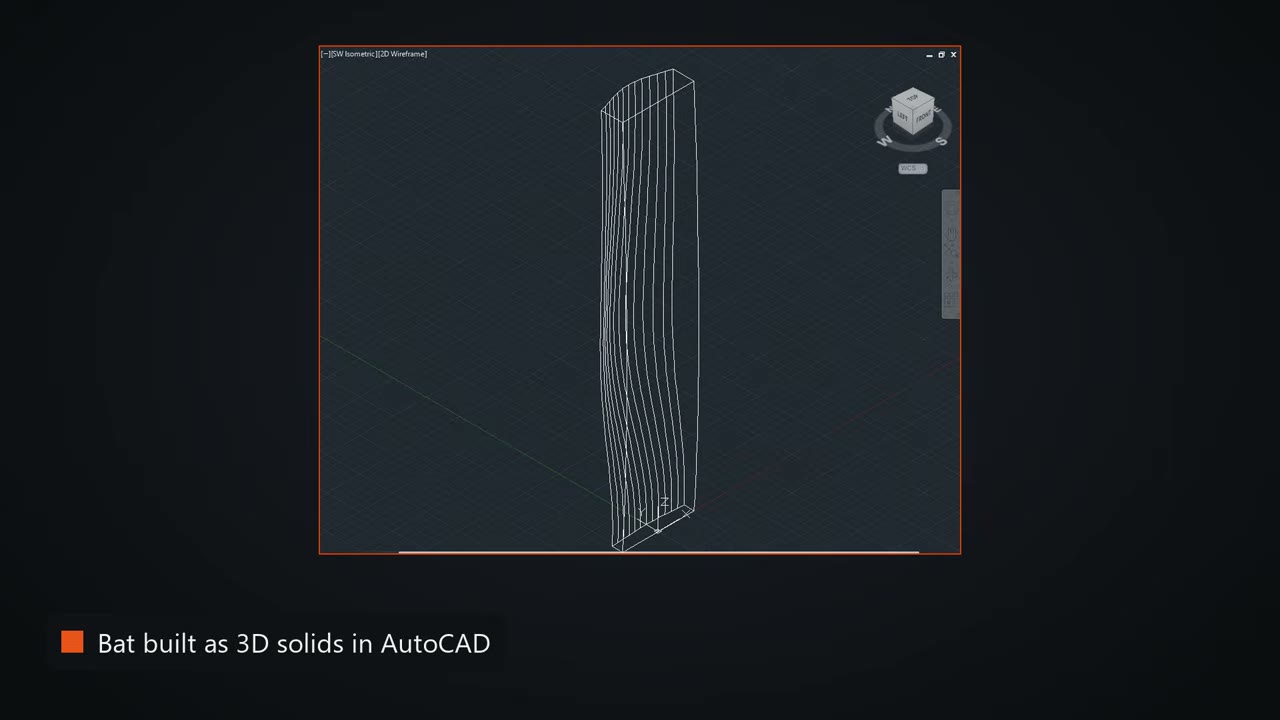
AutoCAD builds the bat from cross sections laid out along the blade and lofted into the spine, the bow and the toe. A cane handle and the splice, the V of the handle going 165 mm into the blade, are added as a second solid.
What we measured
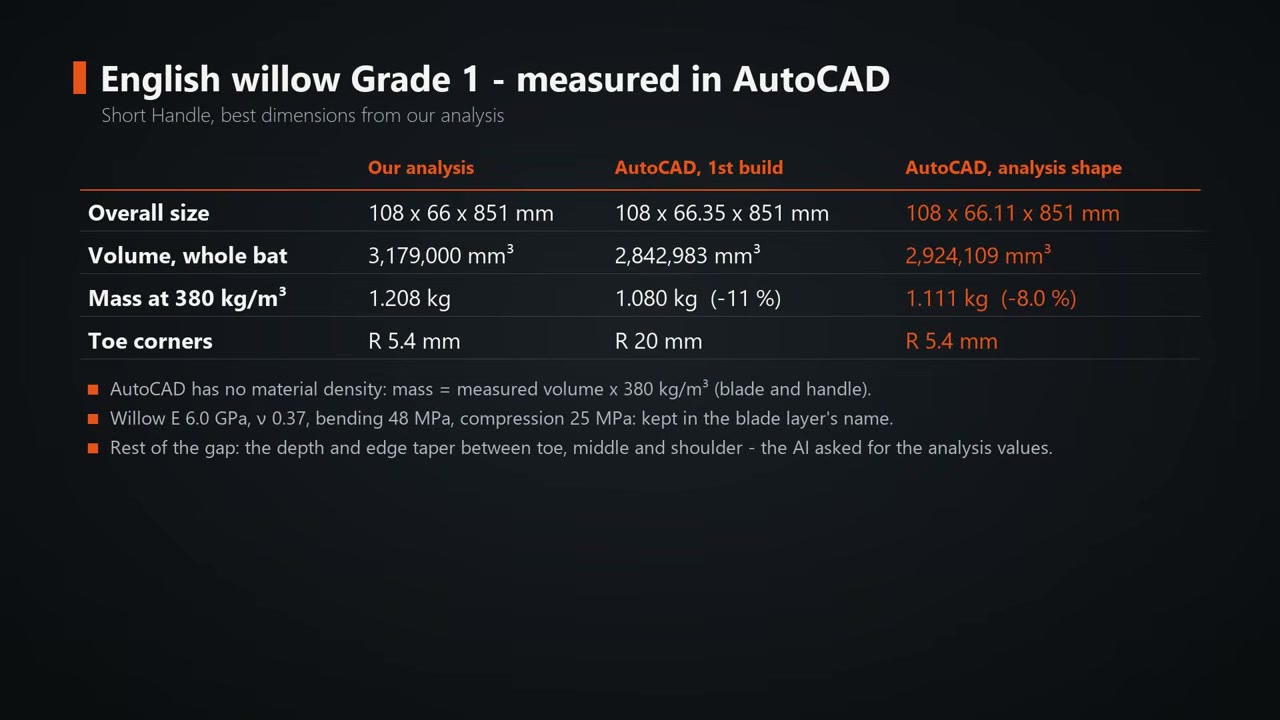
AutoCAD has no material density, so the mass is the measured volume multiplied by the grade's density. The first build measured 1.080 kg, 11 % under the analysis bat's 1.208 kg. The agent was asked to rebuild the blade to the analysis shape, with full edges, a parabolic back and small toe corners, and the volume rose from 2,842,983 to 2,924,109 mm³. That gave 1.111 kg, 8.0 % under.
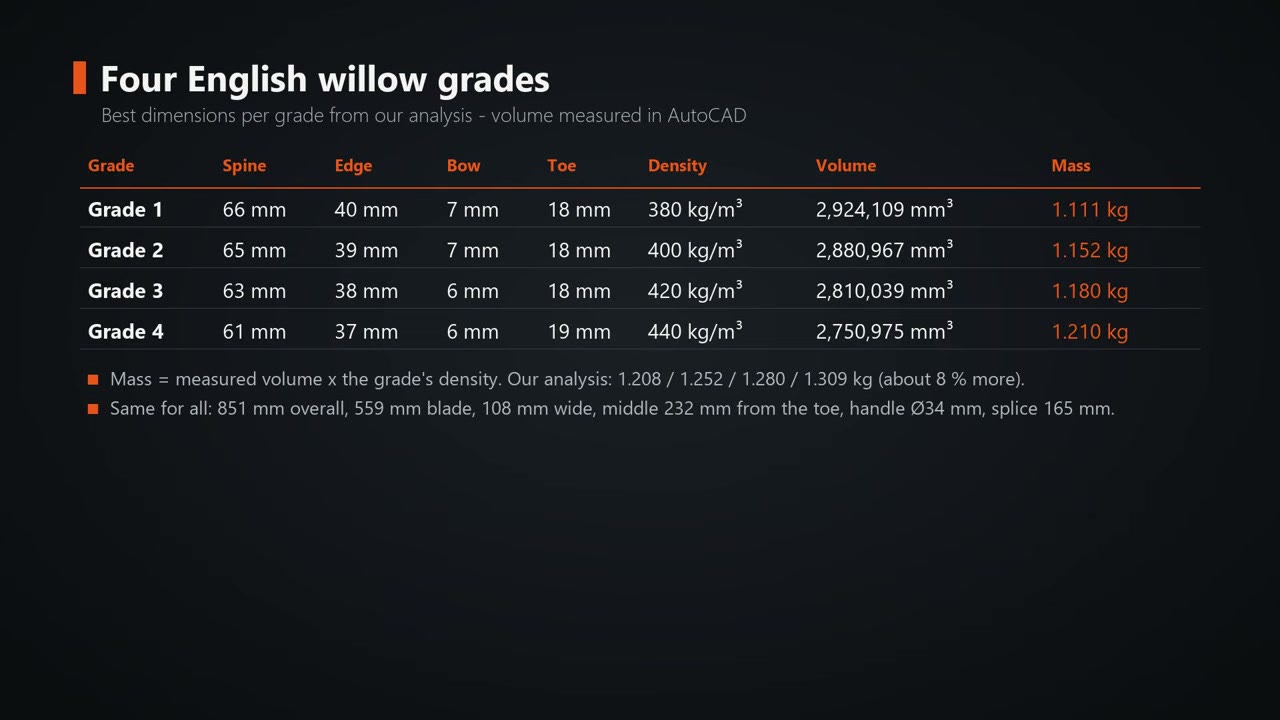
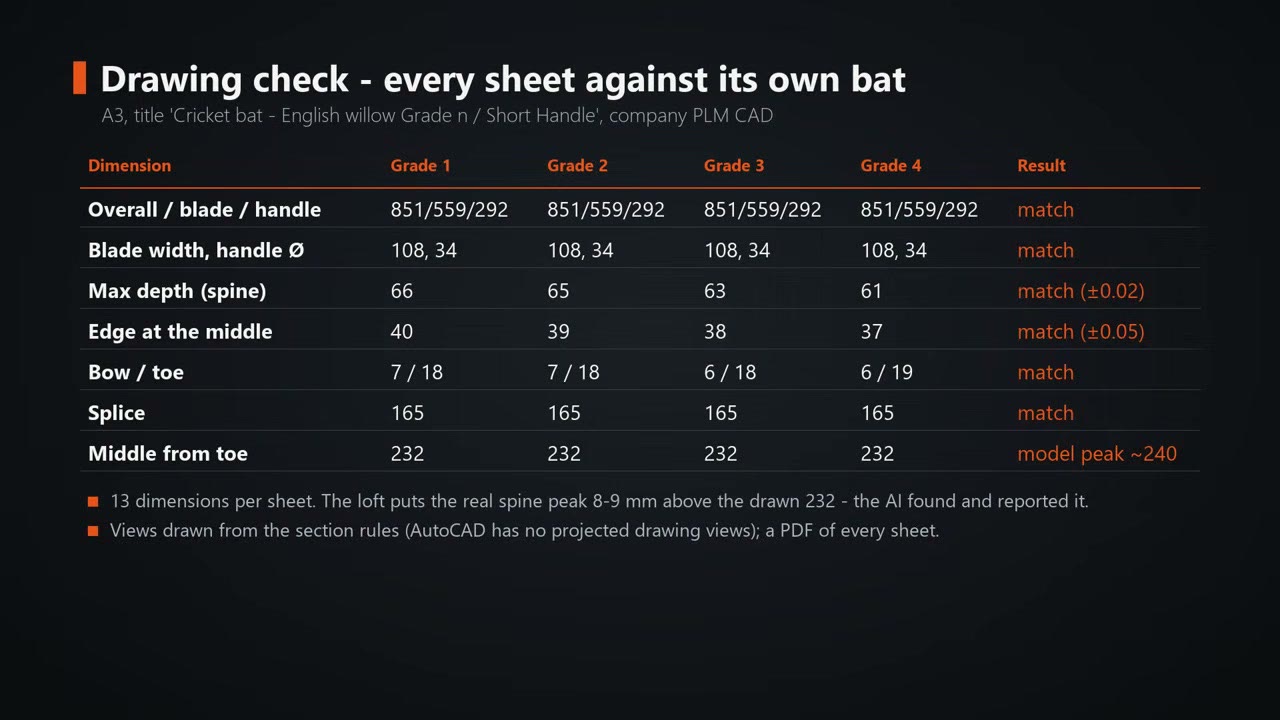
Grades 2, 3 and 4 follow with their own spine, edge, bow and toe values, and a 6 mm bow for Grades 3 and 4. The masses are 1.111, 1.152, 1.180 and 1.210 kg. All four share an 851 mm overall length, a 559 mm blade, a 108 mm width, a middle 232 mm from the toe and a 34 mm handle diameter. The denser the willow, the slimmer the bat, yet the weight still climbs.
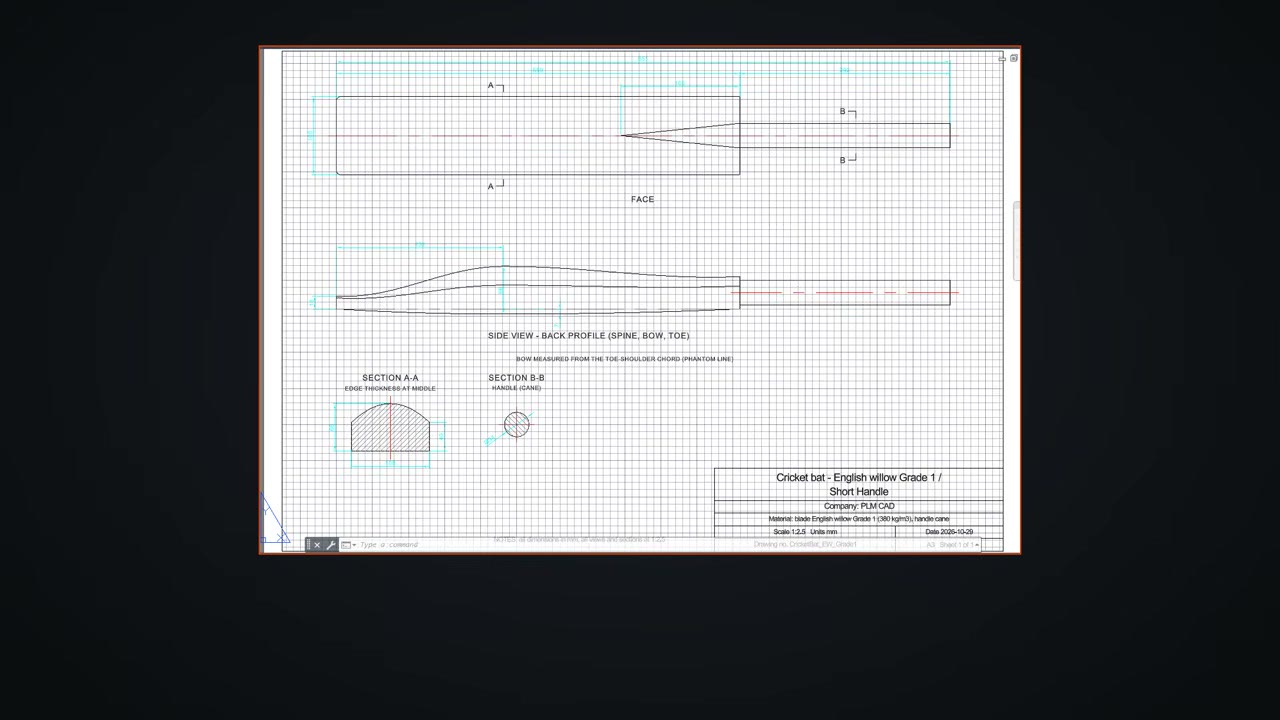
The A3 drawing of the Grade 1 bat carries the face, the back profile with spine, bow and toe, a section at the middle and the handle on a layout with a title block. The next request, for the other three grades, included: "Check every dimension on each sheet against its own model, row by row, and tell me anything missing or different." A PDF was saved for every sheet.
What did not work
The drawing check found one difference. The 13 dimensions per sheet all match except the position of the spine peak: the smooth loft puts the peak about 8 mm higher than the 232 mm on the sheet, and the table shows the model peak at about 240 mm. The agent found it itself and reported it. Two rows match only within a tolerance, maximum depth within 0.02 and edge at the middle within 0.05.
The last request put all four bats side by side in one drawing, Grade 1 on the left to Grade 4 on the right, each in its own willow colour.
Try it yourself
SphereHarness for AutoCAD is described at /autocad, and /help/getting-started walks through the first install and the first request.