

Parametric cricket bat in Inventor: five willows, FEA and drawing
A parametric bat built in Inventor, four sizes from one parameter set, five willows, an Inventor Nastran impact and modal study, and an A3 drawing.

The video plays from YouTube’s privacy-enhanced player only after you click it.
SphereHarness designed a cricket bat in Autodesk Inventor from plain-English requests: a parametric model inside MCC Law 5, four sizes from one parameter set, five willow grades, a Nastran impact and modal study, and an A3 drawing. The Short Handle bat in English willow Grade 1 weighs 1.202 kg in the study, and the improved profile re-ran at 1.208 kg.
What was asked
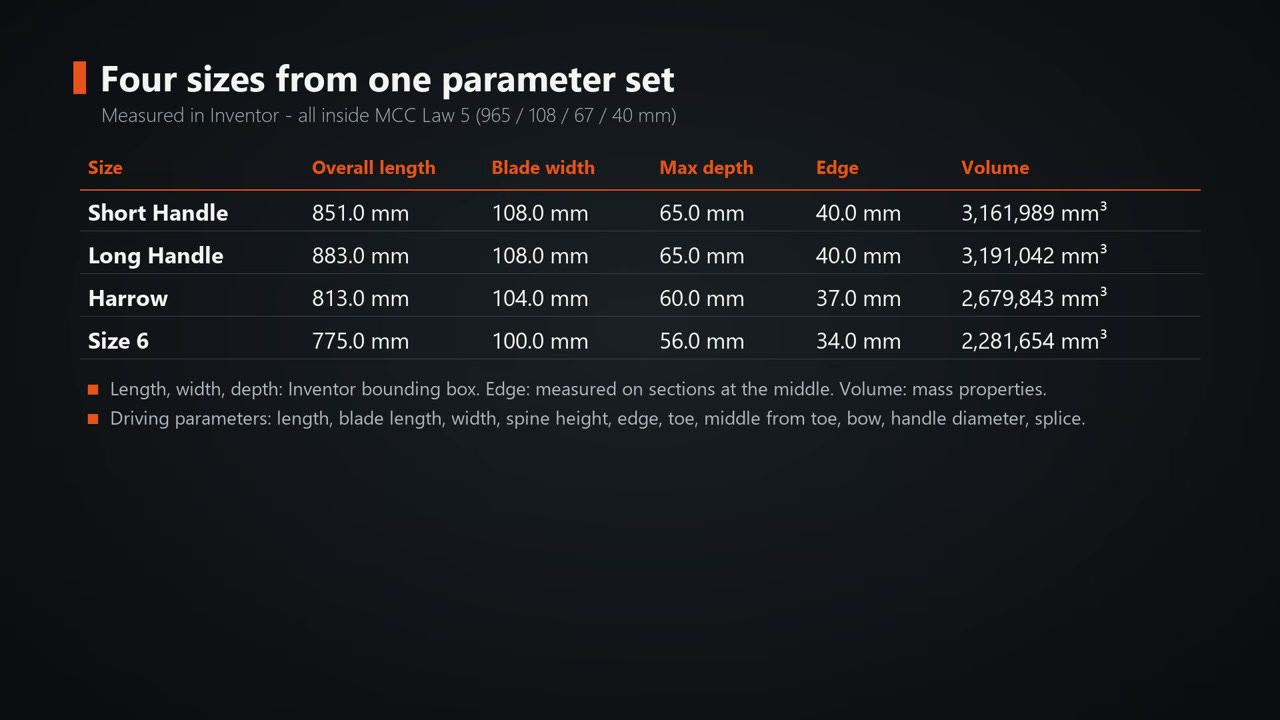
The request names the Laws of Cricket (MCC Law 5) as the limit: the bat has to stay inside the Law 5 limits of 965 mm length, 108 mm width, 67 mm depth and 40 mm edge. The video then asks for sizes, willow grades, a study and a drawing, one after the other.
What the agent did
The bat is built from user parameters. Five cross sections are lofted, shoulders and a splice are added, and a handle completes the model. The driving parameters are length, blade length, width, spine height, edge, toe, middle position from the toe, bow, handle diameter and splice.
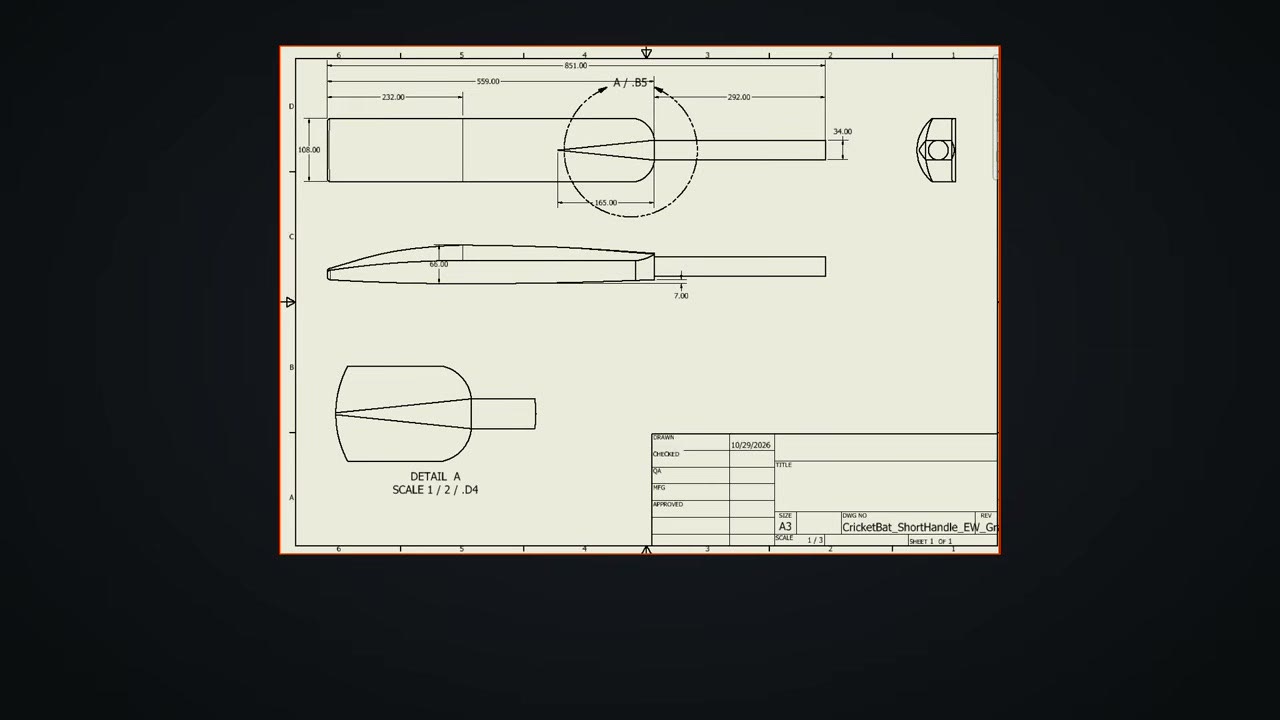
Four sizes come from the same parameter set: Short Handle at 851.0 mm overall, Long Handle at 883.0 mm, Harrow at 813.0 mm and Size 6 at 775.0 mm.
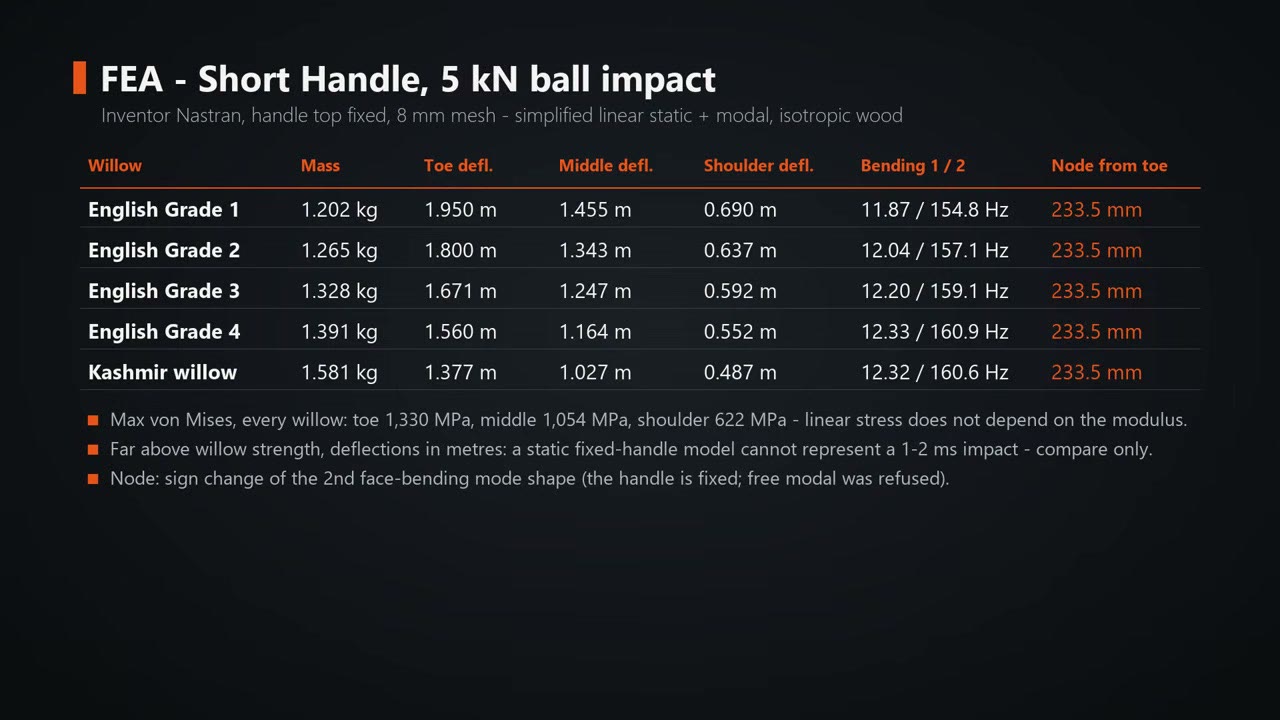
Five willows are compared: English willow Grades 1 to 4 at 380, 400, 420 and 440 kg/m³, and Kashmir willow at 500 kg/m³. On the Short Handle the masses run from 1.202 kg to 1.581 kg.
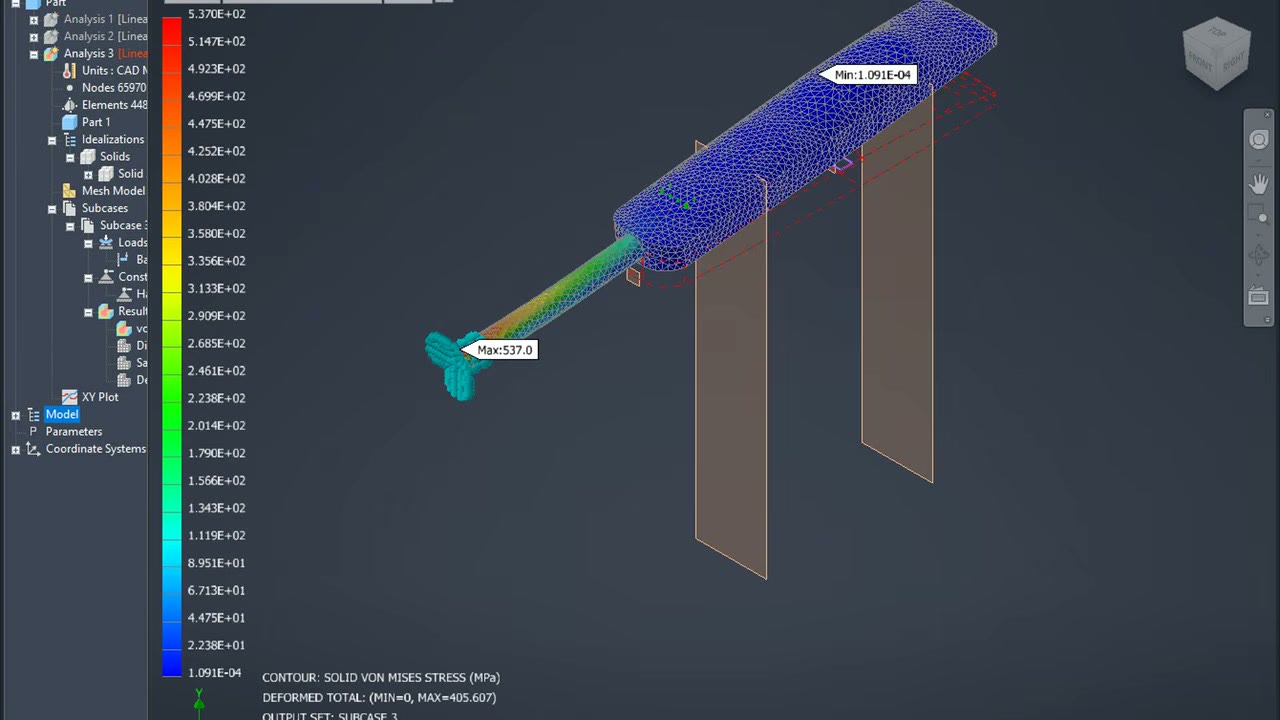
The study in Inventor Nastran applies a 5 kN ball impact at the toe, the middle and the shoulder with the handle top fixed and an 8 mm mesh, plus a modal analysis.
What we measured
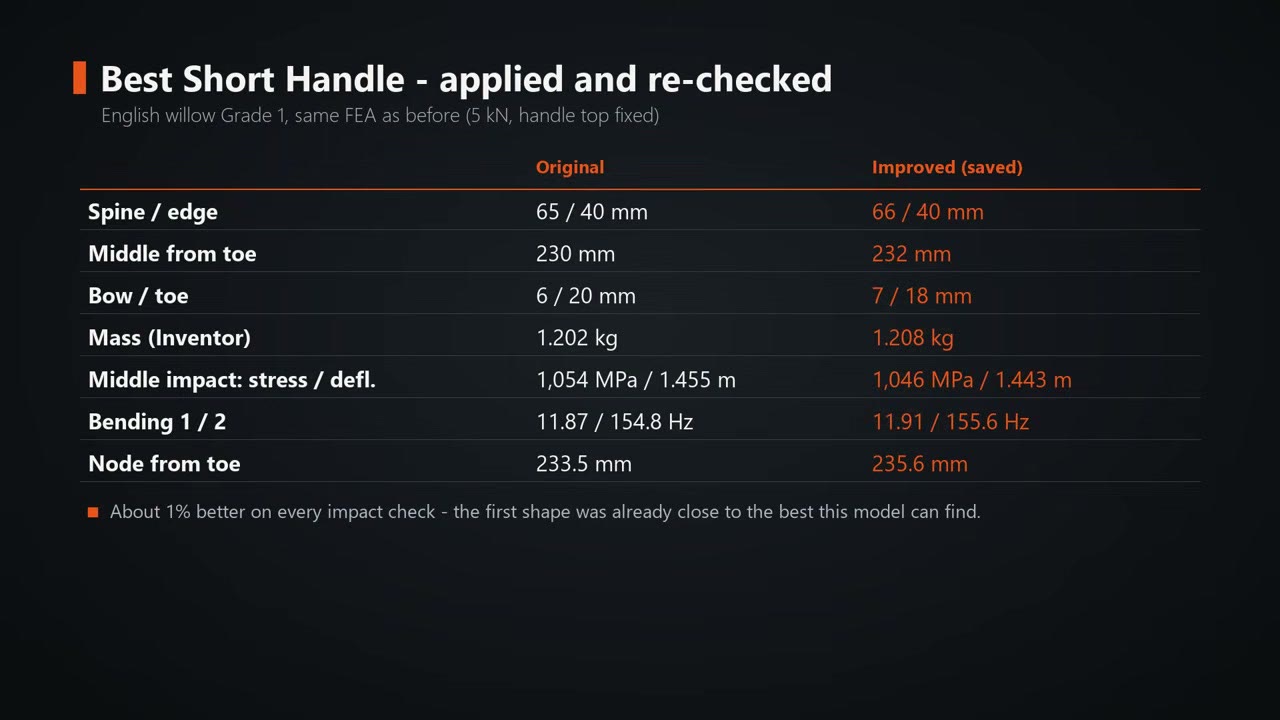
For Grade 1 the first two bending frequencies are 11.87 and 154.8 Hz, and the vibration node sits 233.5 mm from the toe. Applying the chosen dimensions (spine 66 mm, edge 40 mm, middle 232 mm from the toe) and re-running the study changed the bending frequencies to 11.91 and 155.6 Hz and moved the node to 235.6 mm. The video describes the gain as about 1 % on every impact check.
The A3 drawing was checked dimension by dimension against the model. The closing table lists 13 bat parameters, 4 volume, mass and balance values, 13 size and profile values, 21 FEA values and 3 node positions, all matching, with one rounding fixed in the FEA row.
What did not work
The study is a simplified linear one, and the video says so. The deflections in metres are far above anything a real 1 to 2 ms impact would produce, so the results are for comparing shapes and willows, not for predicting real deflection.
Try it yourself
SphereHarness for Autodesk Inventor is described at /inventor, and /help/getting-started walks through the first install and the first request.