

Engine mount bracket resonance found and fixed in Inventor
An Inventor Nastran study puts mode 1 of an engine mount bracket at 190.5 Hz, inside the firing band; a thicker upright moves it to 297.8 Hz.

The video plays from YouTube’s privacy-enhanced player only after you click it.
SphereHarness built an engine mount bracket in Autodesk Inventor, ran an Inventor Nastran frequency study, found the first mode at 190.5 Hz inside the engine's firing band, and fixed it by making the upright thicker. After the change, mode 1 re-solved at 297.8 Hz, outside the band.
What was asked
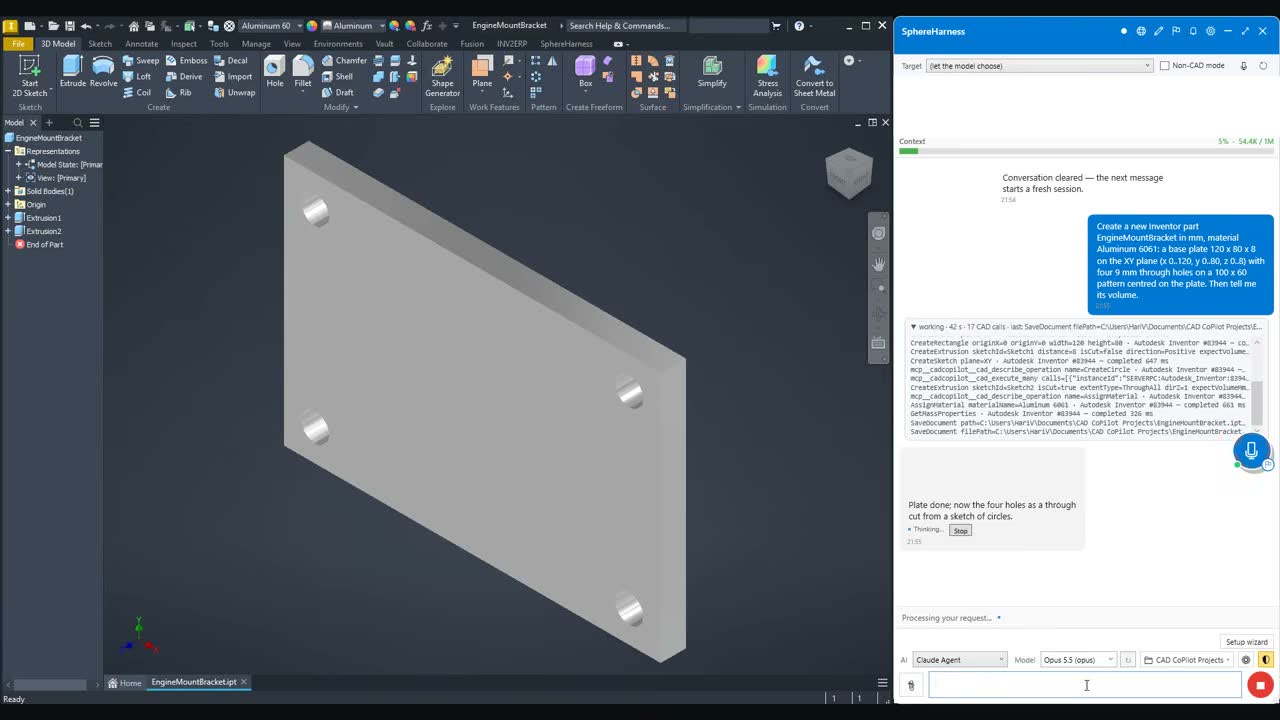
The first request, as typed in the chat: "Create a new Inventor part EngineMountBracket in mm, material Aluminum 6061: a base plate 120 x 80 x 8 on the XY plane (x 0..120, y 0..80, z 0..8) with four 9 mm through holes on a 100 x 60 pattern centred on the plate. Then tell me its volume."
What the agent did
The agent sketched the plate, extruded it 8 mm, cut the four holes and assigned aluminium. Inventor measured 74,764 mm³, which matched the hand calculation. It then added an upright 80 mm wide and 150 mm tall with a 14 mm mount hole and a 5 mm fillet. The upright thickness is a named parameter, UprightThickness, set to 5 mm.
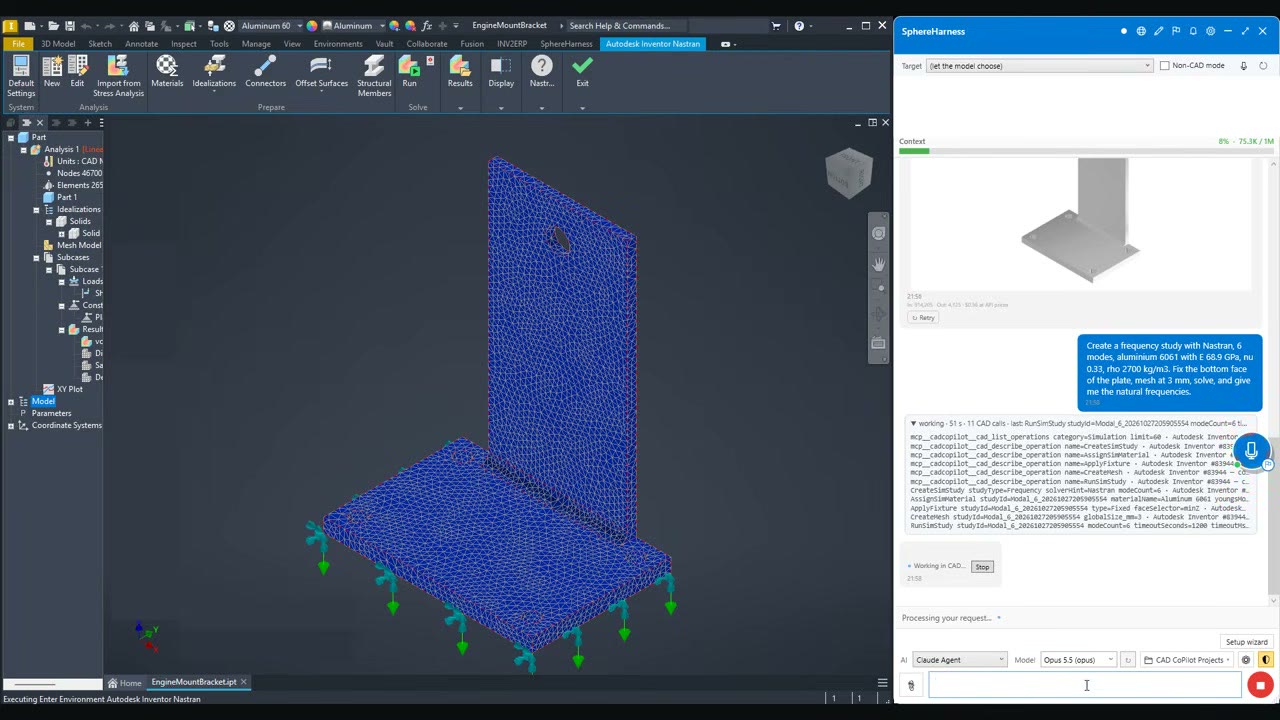
The study request read: "Create a frequency study with Nastran, 6 modes, aluminium 6061 E 68.9 GPa, nu 0.33, rho 2700 kg/m3. Fix the bottom face of the plate, mesh at 3 mm, solve, and give me the natural frequencies."
What we measured
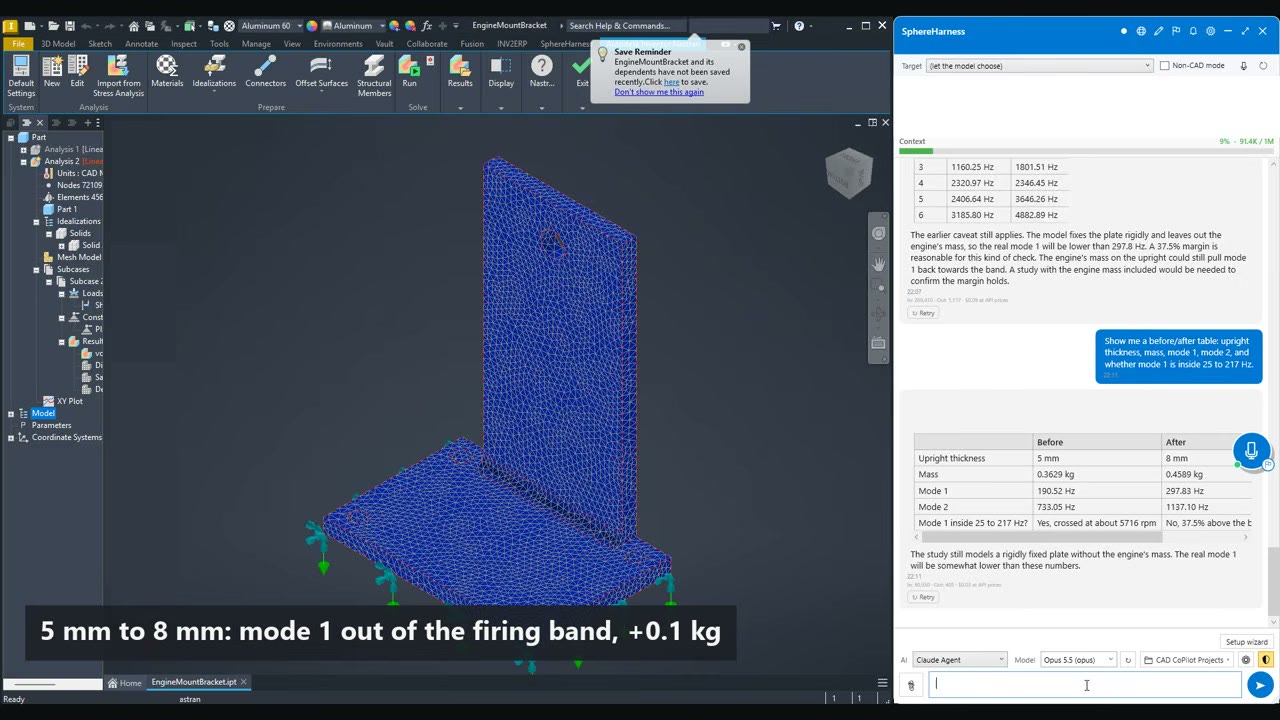
Mode 1 came back at 190.5 Hz, close to the agent's own hand estimate of about 181 Hz. The next question was: "The bracket holds an engine: a 4-cylinder, idle 750 to redline 6500 rpm. Does the 2nd firing order hit any of these modes?" The answer was yes: the 2nd order runs from 25.0 Hz at idle to 216.7 Hz at the redline, and mode 1 at 190.5 Hz sits inside that band, with resonance at about 5,716 rpm.
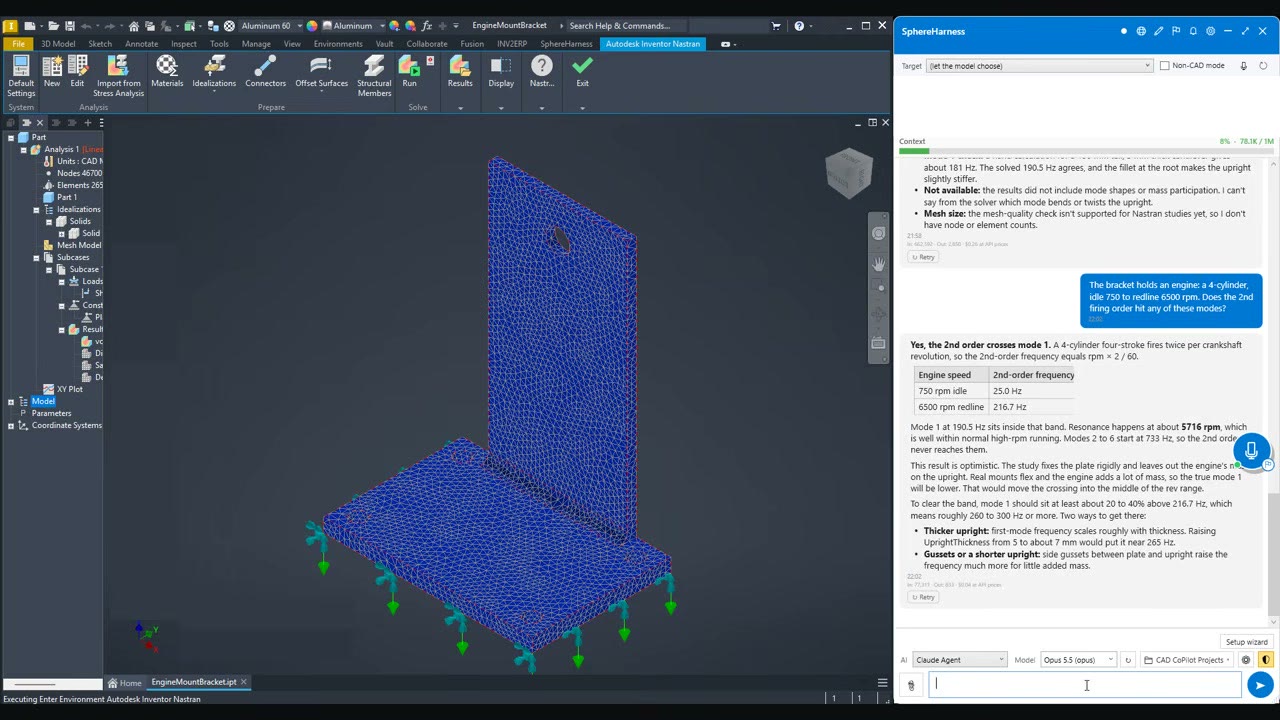
The fix was typed as: "The first mode is inside the firing band. Change UprightThickness from 5 to 8 mm, give me the new mass, and open the Parameters dialog again so I can see the change."
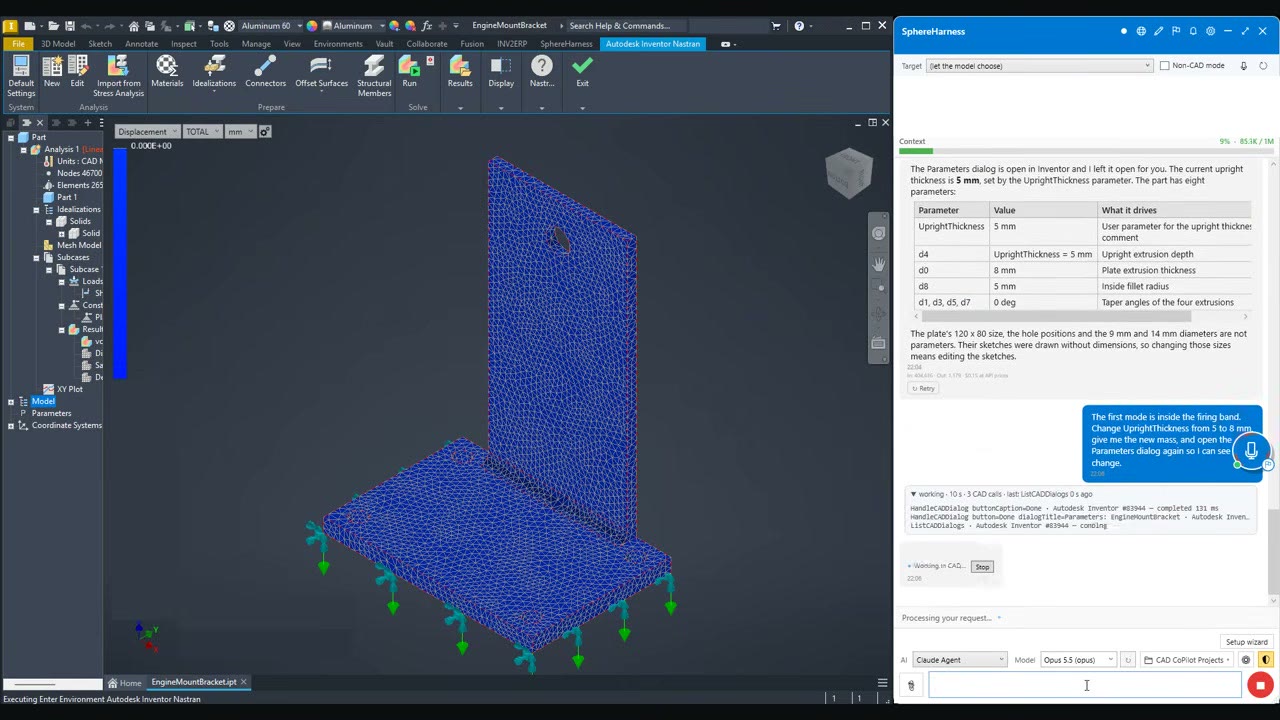
After the rebuild the mass was 0.4589 kg, up from 0.3629 kg. The re-solved study gave mode 1 at 297.83 Hz, 37.5 % above the top of the band. The before and after table shows mode 2 at 733.05 Hz before the change as well.
The agent then wrote a Word report of the study, with the geometry, the setup, all six frequencies and the comparison.
What did not work
The agent pointed out a limit itself: the study fixes the plate rigidly and leaves out the engine's mass, so the real mode 1 will be lower than 297.8 Hz. It also said the Nastran results did not include mode shapes, so it could not say which mode bends or twists the upright.
Try it yourself
SphereHarness for Autodesk Inventor is described at /inventor, and /help/getting-started walks through the first install and the first request.