

Mars rover with 36 components built in Autodesk Inventor
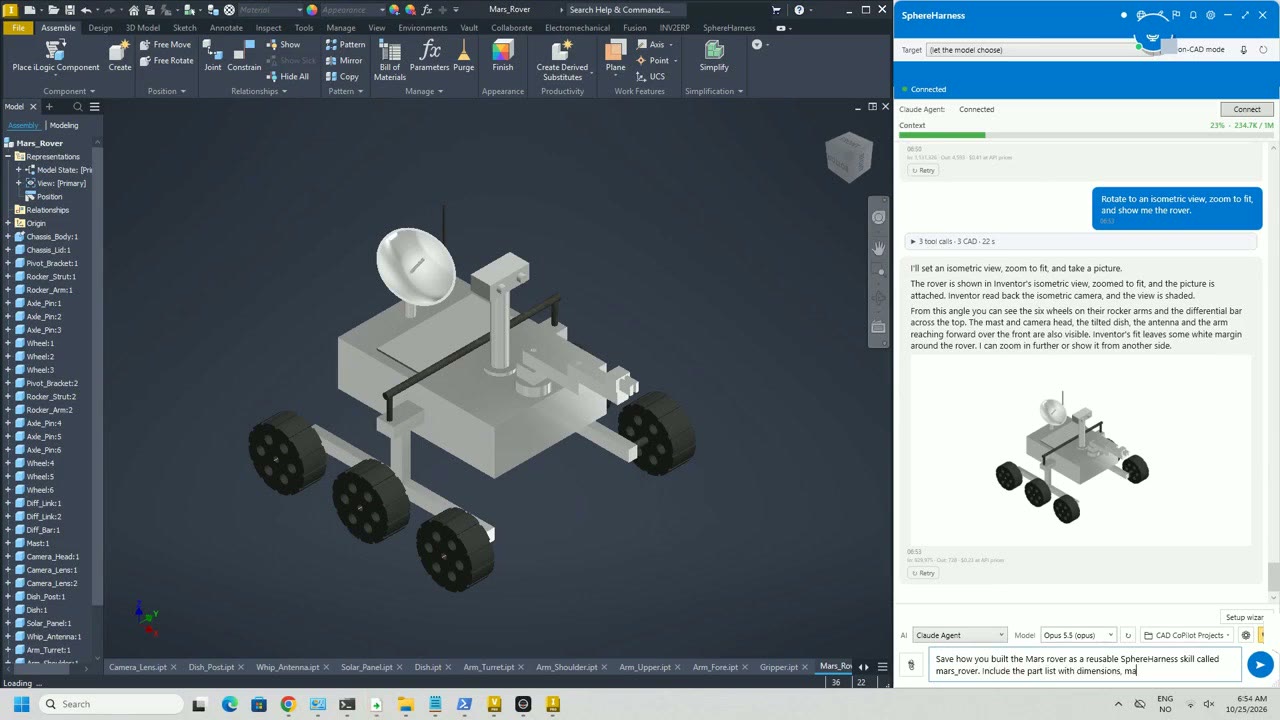
A simplified Mars rover, 21 parts and 36 components, built in Inventor by typed requests; 0 overlaps in 630 pairs and 40.01 kg measured.

The video plays from YouTube’s privacy-enhanced player only after you click it.
SphereHarness built a simplified Mars rover in Autodesk Inventor from typed requests: 21 parts, 36 components, 980 x 800 x 690 mm. The agent measured the finished assembly at 40.01 kg with no interference in 630 pairs, and it reported the gap to the 42.6 kg the owner expected instead of tuning densities to close it.
What was asked
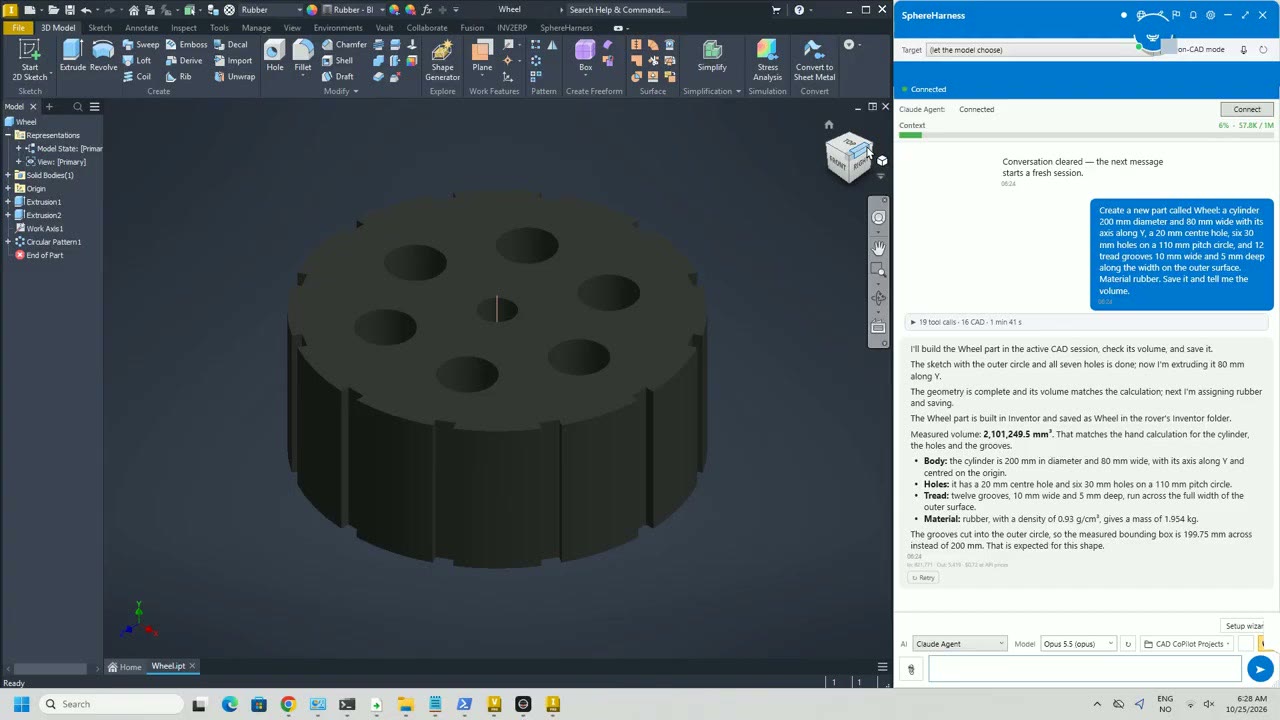
Inventor was empty at the start, and the only input was requests to the SphereHarness desktop agent running Claude Opus. The first one, as typed: "Create a new part called Wheel: a cylinder 200 mm diameter and 80 mm wide with its axis along Y, a 20 mm centre hole, six 30 mm holes on a 110 mm pitch circle, and 12 tread grooves 10 mm wide and 5 mm deep across the width on the outer surface. Material rubber. Save it and tell me the volume."
What the agent did
For the wheel the agent sketched it, extruded it, patterned the groove, assigned rubber and saved it. It reported a measured volume of 2,101,249.5 mm³, which matched its own calculation, and a mass of 1.954 kg at 0.93 g/cm³.
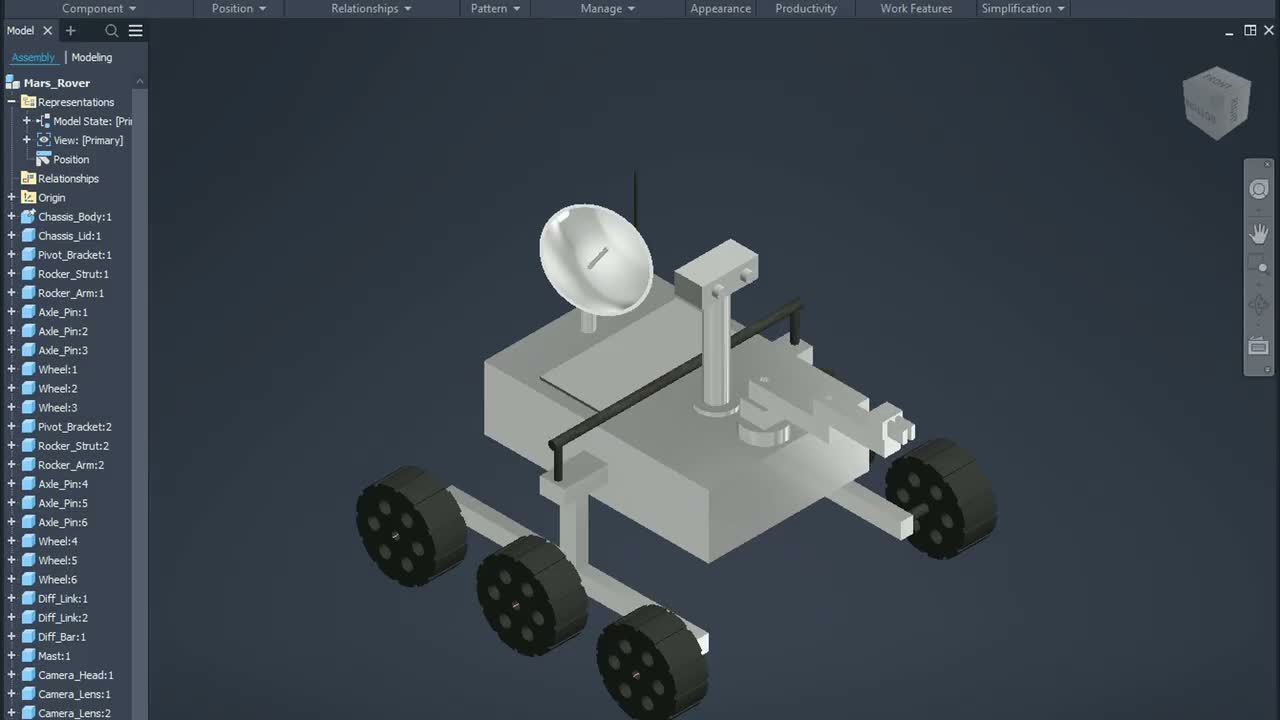
The other parts followed the same loop of build, measure and save: the axle pin, a chassis box shelled to 6 mm with an open top and its lid, the rocker arm, strut, pivot bracket, differential bar and links, the mast, camera head and lenses, the dish, and the five parts of the arm. Before assembling anything, the agent re-measured every saved part and compared six against the stated numbers. Five matched exactly and the wheel was off by a tiny fraction of a percent, so nothing needed fixing.
The assembly grounds the chassis, adds the lid, builds the left side from a bracket, strut, rocker, three pins and three wheels, then repeats it turned 180 degrees for the right side. The differential, the mast and camera, the dish tilted 35 degrees and the arm in a straight reach complete it.
What we measured
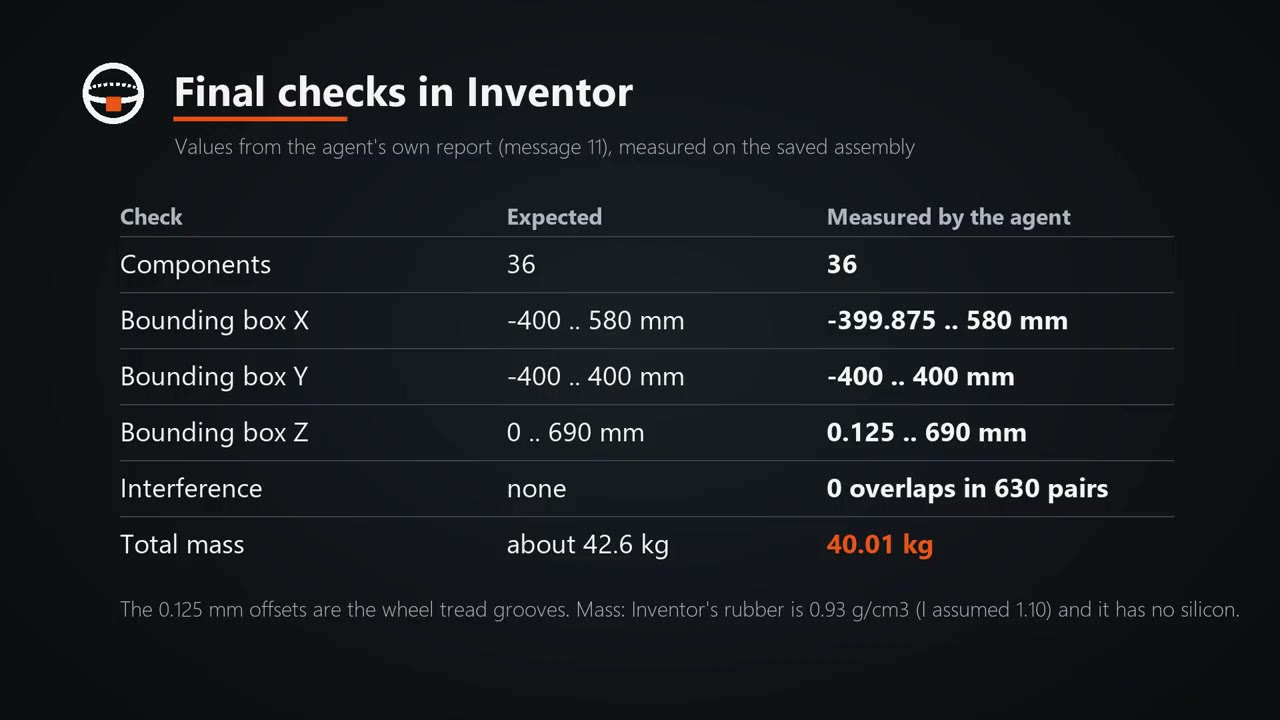
The agent's final report, measured on the saved assembly: 36 components, a bounding box of 979.9 x 800 x 689.9 mm, no interference in 630 pairs and a total mass of 40.01 kg. The 0.125 mm offsets on the bounding box are the wheel tread grooves.
What did not work
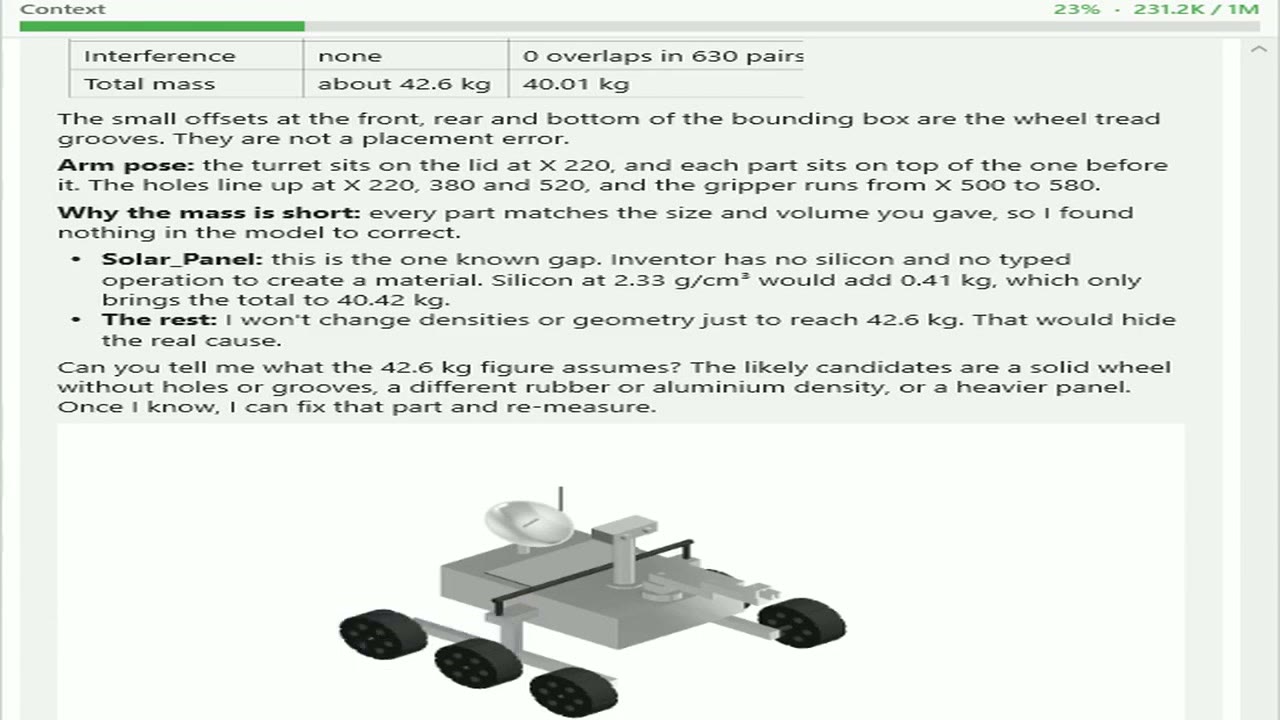
The mass did not match the expectation. The owner expected about 42.6 kg and the agent measured 40.01 kg. It traced the gap to two causes and did not change densities or geometry to reach 42.6 kg: Inventor's rubber is 0.93 g/cm³ where 1.10 had been assumed, and Inventor has no silicon material for the solar panel, which stayed on a generic material. The agent also asked what the 42.6 kg figure assumed, listing a solid wheel, a different aluminium density or a heavier panel as likely candidates.
Saved as a skill
The last request asked the agent to save how it built the rover as a reusable skill called Mars_Rover, with the parts, the placements and the checks.
Try it yourself
SphereHarness for Autodesk Inventor is described at /inventor, and /help/getting-started walks through the first install and the first request.